
Why This Condition Is Frequently Missed
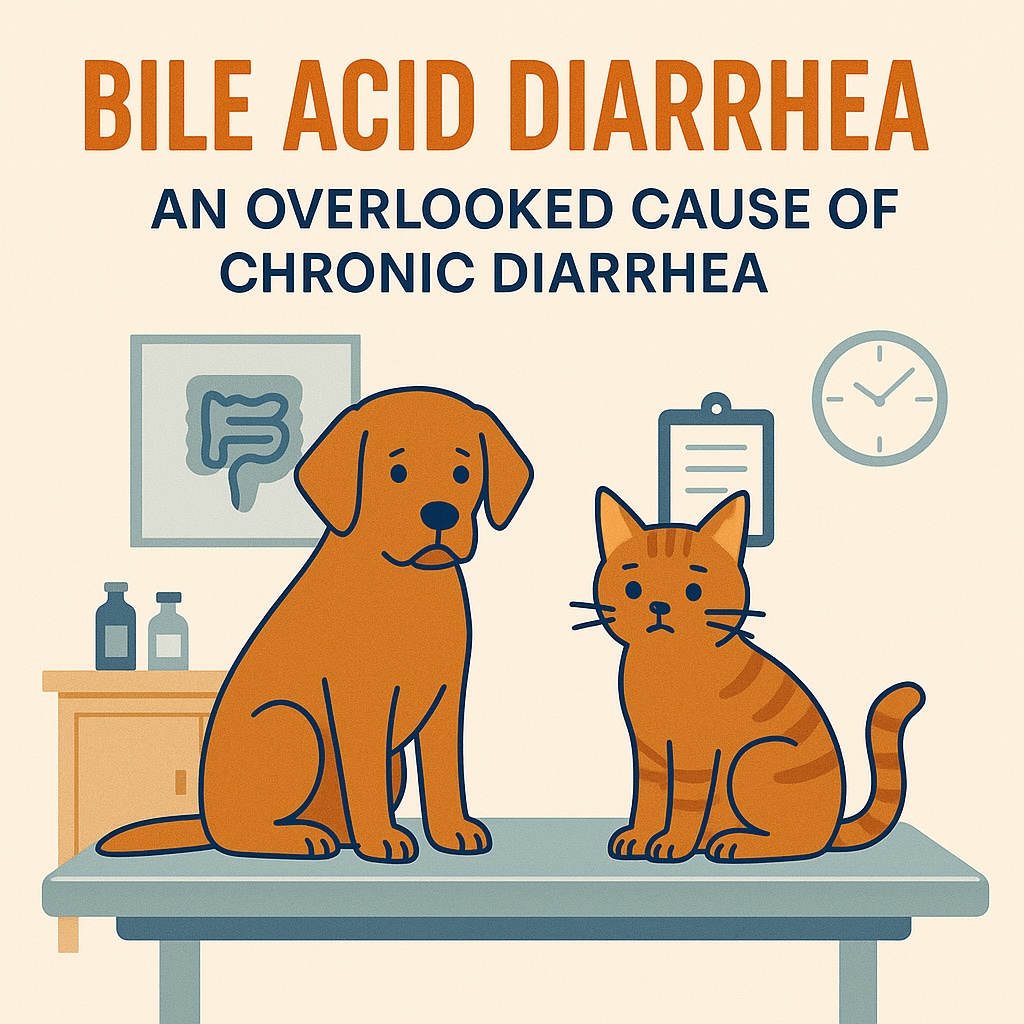
Chronic diarrhea remains a diagnostic challenge in veterinary practice. Many cases receive extensive work-ups (e.g., diet trials, antimicrobials, probiotics, even biopsies) but continue to persist. One reason for this is that the condition termed bile acid diarrhea (BAD) (or bile acid malabsorption) is still insufficiently recognized in dogs and cats.
Recent data suggest that in dogs with chronic enteropathies (CE), there is markedly reduced expression of the ileal apical sodium-dependent bile acid transporter (ASBT) and altered bile acid metabolism (e.g., increased primary bile acids, decreased secondary bile acids). In other words, the “recycling” of bile acids is disrupted, allowing excess bile acids to spill into the colon and drive diarrhea. Given this mechanistic basis, we should shift from regarding BAD as a “last resort” diagnosis to one we consider early in the differential list when faced with chronic, non-responsive diarrhea.
Normal Bile Acid Physiology
- Bile acids (BAs) are synthesized in the liver from cholesterol, conjugated (in dogs and cats often with taurine or glycine) and stored in the gallbladder.
- When food (especially fat) reaches the duodenum, BAs are released to support emulsification of dietary fats and absorption of fat-soluble vitamins.
- Approximately 95% of BAs are reabsorbed in the ileum (via ASBT) and returned to the liver via the enterohepatic circulation.
- The remaining small fraction passes to the colon where gut bacteria, notably species such as Peptacetobacter (Clostridium) hiranonis in dogs, convert primary bile acids into secondary bile acids.
When this efficient system fails, problems arise.
Pathophysiology: How Bile Acid Diarrhea Develops
1. Malabsorption or Reduced Ileal Uptake of Bile Acids
In dogs with chronic enteropathy, studies have shown decreased ileal expression of ASBT, meaning less bile acids are reclaimed, so more reach the colon. This leak causes higher luminal bile acid concentrations distally.
2. Dysbiosis of Bile Acid–Converting Microbiota
When conversion of primary to secondary bile acids is impaired (e.g., low P. hiranonis abundance), the profile shifts toward more primary bile acids, which appear more irritant to the colon.
3. Colonic Irritation and Secretory Mechanisms
Excess bile acids in the colon trigger:
- Secretion of water and electrolytes into the lumen
- Increased mucosal permeability
- Acceleration of colonic motility
These combined effects manifest as diarrhoea (oftentimes watery, frequent, urgent).
4. Secondary Impacts
- Loss of fat-soluble vitamins if bile acid binding/sequestration is used long-term
- Possible nutritional consequences if bile acid malabsorption persists
- In chronic enteropathy patients, bile acid diarrhea may represent a treatment-refractory mechanism rather than merely “steroid-resistant IBD”.
The case report of two dogs treated with the bile acid sequestrant cholestyramine showed dramatic improvement after other therapies failed.
Clinical Presentation
Since bile acid diarrhea overlaps clinically with many other GI disorders, vigilance is key.
Typical features:
- Chronic soft to watery stools, often persistent despite diet/probiotic/antibiotic trials
- Increased frequency or urgency of defecation
- Sometimes flatulence or mild abdominal discomfort
- May maintain appetite, weight and activity until disease becomes more advanced
- Especially suspect in cases labelled “non-responsive enteropathy” (NRE) in dogs (5–27% of CE cases) where bile acid dysmetabolism may be contributory.
Given this, early consideration of BAD is advised rather than waiting until all other causes have been exhausted.
Diagnostic Approach
Step 1: Rule Out Common Causes
- Fecal parasite screening and culture
- Serum cobalamin/folate, TLI for EPI
- Abdominal ultrasound
- Endoscopic or surgical biopsy when indicated
Step 2: Consider Bile Acid Malabsorption
Since veterinary‐specific diagnostic assays remain limited, the following principles apply:
- Studies in dogs show altered fecal bile acid profiles and ASBT expression, but no large‐scale standardized reference intervals yet.
- Available human tests (e.g., serum 7α-hydroxy-4-cholesten-3-one [C4], FGF-19, ^75SeHCAT) are not widely available in veterinary medicine.
- Therefore, clinical suspicion + therapeutic trial (with a bile acid‐binding resin) is currently the most pragmatic path.
Step 3: Therapeutic Trial as Diagnostic Aid
- Initiate cholestyramine (see treatment section)
- Monitor stool quality and frequency
- If rapid and sustained improvement → strongly supports BAD diagnosis
- If no improvement: reassess underlying disease, diet, microbiome, consider dosage escalation
Treatment Strategies
1. Bile Acid-Binding Agents
Cholestyramine remains the primary agent used in veterinary medicine:
- Dogs: ~0.5–2 g PO every 12–24 h (adjust to effect)
- Cats: ~0.25–0.5 g PO every 12–24 h
- Give with food to improve binding and tolerability
- Monitor long-term for fat-soluble vitamin malabsorption (A, D, E, K) given prolonged sequestration of bile acids
2. Dietary Management
- Low-fat, highly digestible diets help reduce bile acid secretory load
- Consider soluble fibre (e.g., psyllium) to improve stool form and slow colonic transit
- In cases where food-responsive enteropathy is possible, elimination diet trials still apply but now with bile acid diarrhea in mind if inadequate response
3. Address Underlying Conditions
Since bile acid malabsorption can be secondary to ileal inflammation, post-surgical ileal resection, EPI, hepatic dysfunction or dysbiosis, management of these underlying issues remains essential for long-term success.
4. Microbiome Support
- Use of veterinary-grade probiotics may help restore bile acid–converting bacterial populations (e.g., P. hiranonis)
- Prebiotics, diet changes, and microbiome monitoring can complement therapy
Prognosis and Clinical Implications
When recognized early and appropriately managed, the prognosis for bile acid diarrhoea is very good. The case report described two dogs who were candidates for euthanasia but improved dramatically with cholestyramine.
The key message for veterinary healthcare professionals:
Shift the mindset! Bile acid diarrhea isn’t a last-resort diagnosis but often a missing piece in the chronic diarrhea puzzle.
By incorporating bile acid diarrhea into the early differential list, particularly for treatment-refractory or ileum‐involved cases, you increase the likelihood of rapid remission, avoid unnecessary prolonged therapies, and improve patient quality of life.
Key Take-Home Points
- Bile acid diarrhea (BAD) is under-recognised in dogs and cats with chronic diarrhea, but mechanistic research now supports its real presence.
- Key pathophysiologic mechanisms in canine CE include reduced ASBT expression and altered bile acid metabolisms (higher primary, lower secondary bile acids).
- When faced with non-responsive diarrhea, consider BAD early rather than only after all other causes have been ruled out.
- A therapeutic trial with cholestyramine can serve both diagnostic and therapeutic purposes.
- Dietary strategy, microbiome support, and underlying disease management remain critical.
- Early recognition and treatment yield excellent outcomes.