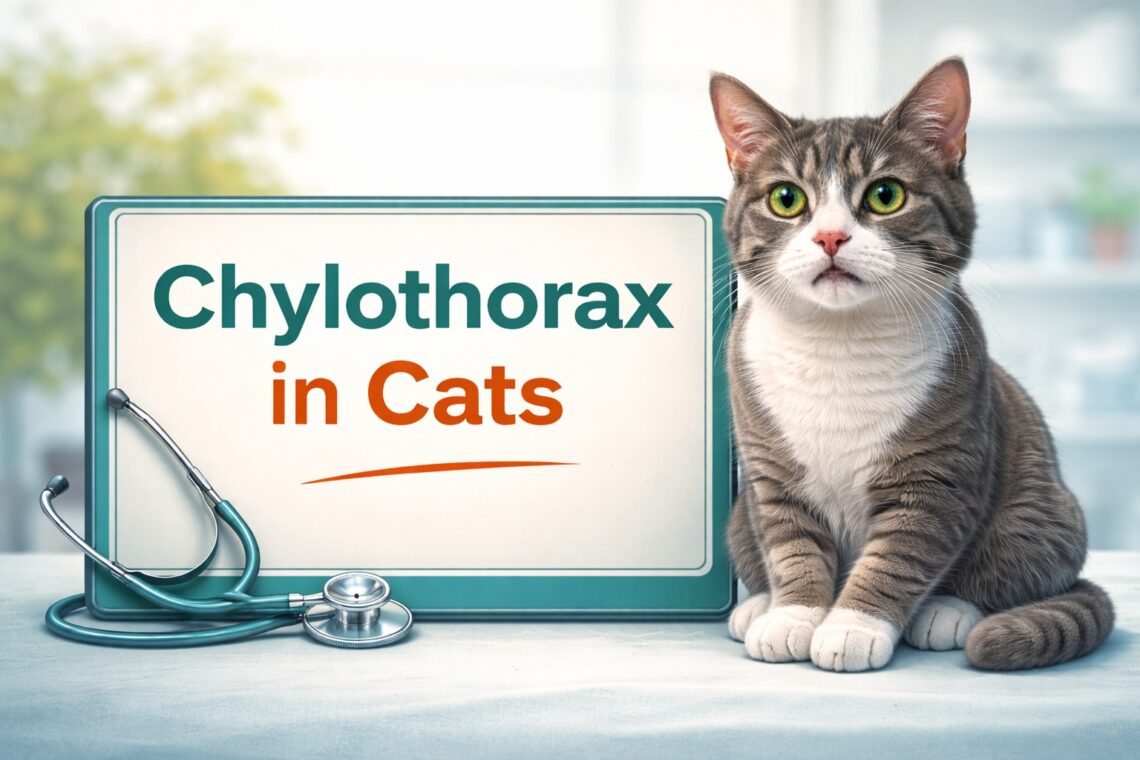

Chylothorax is a serious and potentially life-threatening condition in cats that interferes with normal breathing. It occurs when chyle, a fat-rich lymphatic fluid, accumulates abnormally in the space between the lungs and the chest wall. Because this fluid prevents the lungs from fully expanding, affected cats can develop rapid respiratory distress and require urgent veterinary care.
This article explains what chylothorax is, why it occurs, how veterinarians diagnose it, and which medical and surgical treatments offer the best outcomes.
What Is Chylothorax?
The thoracic cavity contains several vital structures, most notably the lungs and heart. During inhalation, the chest wall expands and the diaphragm contracts. These coordinated movements decrease pressure within the pleural space, which allows the lungs to expand and fill with oxygen-rich air.
Under normal circumstances, the pleural space contains no air and only a very small amount of fluid, typically less than 5 mL. Veterinarians therefore describe it as a potential space. However, when disease causes excessive fluid accumulation, lung expansion becomes restricted and oxygen delivery declines.
One type of abnormal pleural fluid is chyle. Chyle appears white to light pink and has a milky appearance, similar to plain or strawberry milk. This appearance reflects its high fat content. Chyle also contains lymphatic fluid, which normally drains from tissues into lymphatic vessels and passes through lymph nodes. When lymphatic flow becomes disrupted, chyle can leak into the pleural space and cause chylothorax.
What Causes Chylothorax in Cats?
Several conditions can interfere with normal lymphatic drainage and result in chylothorax, including:
- Heart disease
- Trauma
- Heartworm infestation
- Certain infections (e.g., fungi, bacterial, feline infectious peritonitis)
- Tumors within the chest cavity
Despite thorough diagnostic testing, veterinarians cannot identify an underlying cause in >50% of affected cats. These cases are classified as idiopathic chylothorax, which simply means the cause remains unknown.
What Does Chylothorax Look Like Clinically?
Cats with pleural effusion typically breathe rapidly and shallowly. Some may also cough. Pet parents most often seek veterinary care because their cat appears to be struggling to breathe. These patients face a real risk of sudden death due to severe respiratory compromise.
Other common clinical signs include:
- Lethargy
- Depression
- Reduced or absent appetite
- Exercise intolerance
Notably, some cats with chylothorax appear relatively stable at first. When fluid accumulates slowly, cats may compensate until the volume reaches a critical threshold, at which point respiratory distress can develop abruptly.
How Is Chylothorax Diagnosed?
Diagnosing pleural effusion is usually straightforward. A thorough history and physical examination often provide important clues. For example, rapid, shallow breathing strongly suggests pleural space disease. On auscultation, heart and lung sounds often seem muffled because fluid surrounds the lungs and heart.
To confirm pleural effusion, a veterinarian will perform chest radiographs and or a procedure called thoracocentesis, which involves removing fluid from the pleural space. Analysis of the collected fluid determines whether it is chyle.
Once chylothorax is confirmed, additional diagnostics may include:
- Blood and urine testing to evaluate organ function
- Screening for feline leukemia virus (FeLV) and feline immunodeficiency virus (FIV)
- Heartworm antigen and antibody testing
- Echocardiography
- Cardiac biomarker testing such as proBNP
- Bacterial and fungal culture of pleural fluid
- Abdominal imaging
- Advanced chest imaging such as computed tomography (CT scan) and lymphangiography
How Is Chylothorax Treated?
Management of chylothorax has two primary objectives.
First, if veterinarians identify an underlying cause, that condition should be definitively treated whenever possible. Second, when no cause is found or while diagnostics and definitive therapy proceed, medical management focuses on stabilizing the patient, reducing chyle formation, and preventing complications.
Treating the underlying cause when identified
When diagnostic testing identifies a specific disease process causing chylothorax, therapy must focus on direct treatment of that condition, since pleural fluid will continue to accumulate until the primary problem is controlled. Examples include:
- Cardiac therapy for cats with heart disease
- Oncologic staging and targeted treatment for cats with tumors
- Antifungal therapy for cats with fungal infections
- Heartworm-specific management for infected cats
In these situations, chylothorax represents a secondary consequence of disease, and supportive care alone will not provide lasting resolution. Definitive treatment of the underlying cause offers the best chance for long-term control.
Unfortunately, veterinarians cannot identify a cause in more than half of affected cats. These patients receive a diagnosis of idiopathic chylothorax, and medical management becomes the primary initial strategy.
Medical management of idiopathic chylothorax
Therapeutic thoracocentesis and supportive care
Cats presenting with respiratory distress require immediate stabilization. Oxygen supplementation and prompt thoracocentesis relieve respiratory compromise and are essential when a cat struggles to breathe. Some cats require repeated thoracocentesis, while others benefit from temporary chest tube placement if fluid reaccumulates rapidly or frequent drainage becomes impractical.
Supportive care also includes appropriate analgesia, anxiolysis, and early nutritional planning. Chronic pleural effusion increases the risk of weight loss and muscle wasting, so nutritional support should not be delayed.
Dietary fat restriction
A very low-fat diet commonly forms part of medical management for idiopathic chylothorax. Long-chain dietary fats enter the lymphatic system as chylomicrons, so reducing dietary fat may decrease the fat content of chyle and improve pleural fluid resorption.
However, veterinary literature emphasizes that fat restriction alone often does not reliably reduce total chyle flow. Therefore, dietary modification should be viewed as adjunctive rather than curative therapy.
Key considerations include:
- Selecting a diet the cat will reliably eat
- Monitoring body weight and muscle condition closely
- Ensuring adequate protein and caloric intake
Medium-chain triglycerides bypass intestinal lymphatics and enter portal circulation directly. Although conceptually appealing, controlled feline data remain limited, so this approach should be considered supportive rather than definitive.
Rutin supplementation
Rutin, a benzopyrone nutraceutical, represents one of the better-described medical adjuncts for idiopathic chylothorax in cats. Case reports and small case series suggest some cats experience clinical improvement when treated with rutin.
Proposed mechanisms include stimulation of macrophage-mediated lipid clearance and reduction in chyle volume over time. Nevertheless, evidence remains limited, and spontaneous resolution of idiopathic chylothorax can occur. For these reasons, clinicians should interpret response cautiously.
Rutin is reasonable for stable cats with idiopathic chylothorax, provided pet families understand that success is variable and improvement may take weeks.
Octreotide and somatostatin analogs in selected cases
Octreotide has been used in human chylothorax management and occasionally in veterinary patients by extrapolation. Evidence in cats remains limited, and optimal dosing and patient selection are not well established.
For this reason, octreotide may be considered in selected cases when conventional medical therapy fails or when surgery is not immediately feasible. However, it should be presented as a non-standard option with unpredictable outcomes.
Monitoring response and escalation of care
Close monitoring remains essential during medical management. Cats that require frequent pleural drainage, continue to lose weight, or develop evidence of chronic pleural inflammation are not responding adequately to conservative therapy.
Prolonged chylothorax increases the risk of fibrosing pleuritis, which significantly worsens prognosis. When medical management fails to control effusion or preserve quality of life, timely referral for surgical consultation becomes the most appropriate next step.ation.
Surgical management
Surgery becomes the preferred option when cats have recurrent effusion despite appropriate medical management, require frequent pleural drainage, lose weight or muscle mass, or show evidence of chronic pleural inflammation. In idiopathic chylothorax, surgical goals include reducing chyle flow into the pleural space, improving lymphatic drainage, and minimizing long-term pleural injury.
Thoracic duct ligation
Thoracic duct ligation interrupts the primary lymphatic conduit carrying chyle into the thorax. However, feline lymphatic anatomy often includes multiple tributaries, and collateral channels may form after ligation. As a result, thoracic duct ligation alone has variable success and is now less commonly used as a single definitive procedure.
Thoracic duct ligation plus subphrenic pericardiectomy
Combining thoracic duct ligation with subphrenic pericardiectomy improves outcomes in many cats. Removing the pericardium reduces resistance to venous and lymphatic drainage, which appears to lower lymphatic pressure and decrease chyle leakage. Many surgeons consider this combination the foundation surgical approach for idiopathic chylothorax.
Cisterna chyli ablation as an adjunct
Cisterna chyli ablation targets the primary lymphatic reservoir in the cranial abdomen. By reducing lymphatic pressure caudal to the thorax, this procedure may limit collateral formation and improve long-term success. Surgeons individualize its use based on disease severity and chronicity.
Pleural ports as a supportive or palliative option
Pleural ports, also called pleurocutaneous access ports, represent an important adjunctive and sometimes palliative option. These systems consist of a subcutaneous access port connected to an indwelling pleural catheter, allowing intermittent drainage without repeated thoracocentesis.
Pleural ports do not treat the underlying cause of chylothorax. Instead, they play specific roles, including:
- Cats that are poor candidates for definitive surgery due to comorbidities
- Cats with refractory chylothorax despite medical and surgical intervention
- Temporary management while awaiting referral or further stabilization
- Reducing stress and morbidity associated with repeated needle drainage
Published veterinary reports describe pleural ports as effective for improving quality of life and reducing hospital visits when families receive appropriate training. However, long-term use carries risks such as infection, catheter obstruction, and pleural fibrosis. For these reasons, pleural ports should be framed as supportive or palliative tools rather than curative therapy.
Omentalisation and other combination techniques
Some surgeons incorporate pleural omentalisation to enhance fluid absorption and provide alternative lymphatic drainage pathways. This approach reflects ongoing evolution toward multimodal surgery for difficult cases, although outcomes vary and case selection remains critical.
Minimally invasive approaches
Thoracoscopic techniques for thoracic duct interruption and partial pericardiectomy have been described in cats. Potential benefits include improved visualization and faster recovery in selected patients, although broader outcome data remain limited compared with open combination procedures.
Why surgery can fail
Recurrence may occur due to missed tributaries, collateral lymphatic channel formation, or delayed intervention with established pleural fibrosis. Chronic disease can limit lung re-expansion even after effusion resolves, which underscores the importance of early referral.
What Is Fibrosing Pleuritis?
Chyle strongly irritates the visceral pleura. Chronic exposure leads to inflammation and scarring, known as fibrosing pleuritis. As fibrosis progresses, the lungs lose their ability to expand normally. Surgical decortication carries substantial risk, so early diagnosis and aggressive treatment offer the best prevention.
Key Take-Home Message
Chylothorax is the accumulation of fat-rich lymphatic fluid in the pleural space and represents a true medical emergency in cats. Whenever veterinarians identify an underlying cause, that disease should be definitively treated. When no cause is found, medical management may provide temporary control, but many cats ultimately benefit from combination surgical approaches. Pleural ports offer meaningful quality-of-life support when definitive cure is not feasible.